

The more capable the agent, the more Forward Deployed Engineers you hire to deploy it
What the 2010s software boom tells us about the state of enterprise AI

A forward deployed engineer is the wise technology expert that looks at your organization and figures out how to automate your specific processes, with your messy data, and your subjective expertise. There’s an uptick in demand for FDE’s, because crossing agentic AI’s deployment gap - going from a promising demo to a functioning automation - is actually quite complicated.
The best insights into the future and scope of forward-deployed engineers hide in the boom (and no bust) of implementation consultants of the 2010s.
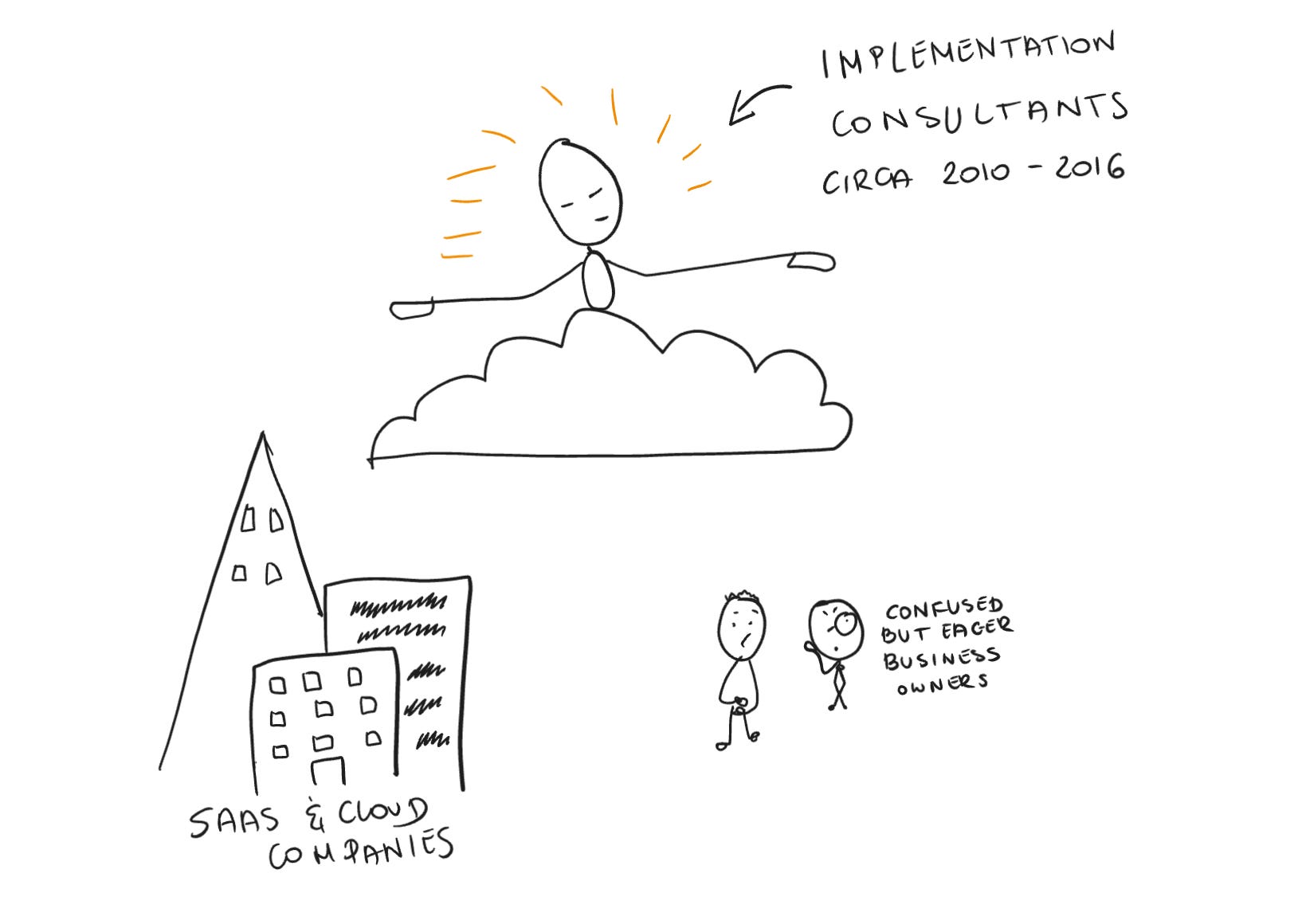
In the mid-2010s, if you were an enterprise using software, you were in the middle of two major shifts. First one was moving away from maintaining your own servers and moving them to cloud; the second was abandoning the upgrade hell of perpetual licenses sold by Oracle et al., and moving to SaaS that updated itself in the background and could be canceled any time.
Old software was pretty good for the seller and cumbersome for the buyer - bought a perpetual license, didn’t use it? The onus is on the buyer to implement it better.
The then-new model - subscriptions - gave buyers more flexibility, but came with a new risk for the seller, shifting the responsibility for implementation onto them. If the buyer doesn’t use it or see the ROI - churn!
And, because as an enterprise buyer, you have a vast but brittle ecosystem of workflows and data, haphazardly stitched together in your old systems, you need someone to hold your hand as you transition them over to SaaS. The mere thought of breaking something, of revenue lost with every minute of downtime, is keeping you up at night. You’ll pay good money to do away with that risk.
So a market of boutique consulting agencies blossomed: Cloud Sherpas, Bluewolf, Appirio, Meteorix, Vlocity - started out independently, eventually partnered closely with the seller (e.g. Salesforce or Workday) and a pretty relationship ensued:
customer got the innovation they wanted,
agency got the business,
seller got the sale and intel on how to build a better, more marketable product.
Eventually, these agencies became such a crucial cog in the software industry machine that a wave of acquisitions followed in the mid-2015:
Sept 2015 Cloud Sherpas est. $350M-$450M) ~1,100 employees
Sept 2015 Meteorix ~$80M - $100M ~180 Workday experts
Mar 2016 Bluewolf $200M+
Oct 2016 Appirio $500M
Dec 2020 Vlocity $1.33B
Do the billions of dollars here foreshadow what’ll happen with FDEs? OpenAI’s recent acquisitions of Northslope and Tomoro, two implementation agencies, are an indicator here. Their $4B fund is a bet to own the hand-holding layer, a concession that the implementation is the hard part now, not the models.
Eventually, as software ossified and became relatively static, the implementation consultant industry evolved:
Software became much easier to adopt, partly because it injected lessons from onboarding the first waves of customers back into the product, and partly because as old-generation companies died and new-generation companies were started, they adopted the SaaS tools and Cloud natively - no complexity to port over;
The jobs of implementation consultants moved in-house, diffused between several different roles: customer success1 (for overall relationship maintenance, retention, and upsell), solutions architects (for the technical implementation and onboarding work), and product managers (for passing the requirements and features back and forth between the customer and the seller). This in-house support focused on the biggest enterprise customers, and outsourced all other work to the partner network.
Implementation consultants filled the service gap - between the muck and complexity of real workflows and SaaS’s blank slate - with a dedicated middleman.
Forward deployed engineers fill this service gap for agents.
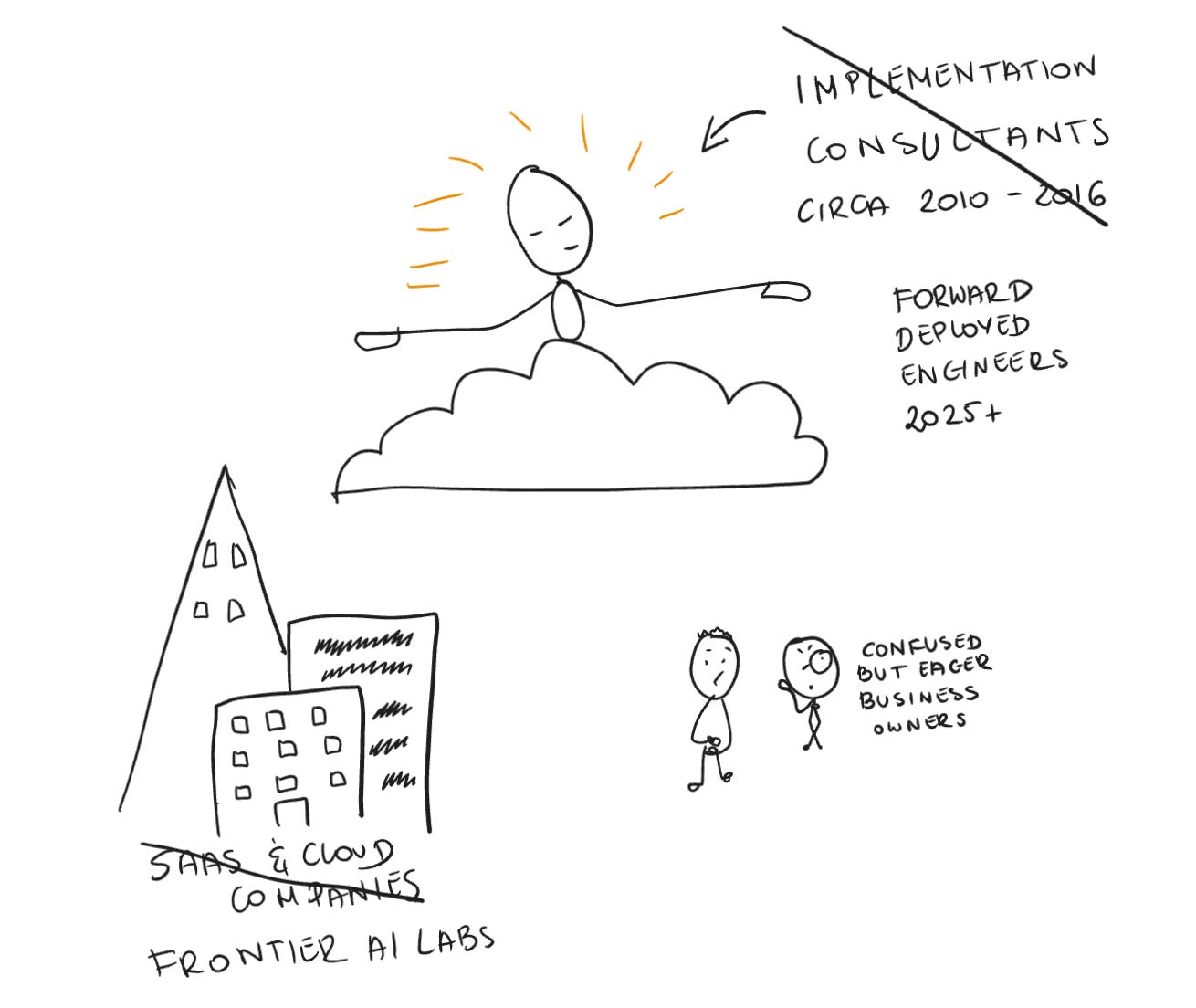
The industry is trudging through the muck of real businesses and real jobs.
The approach of throwing tokens at the wall turned out to be extremely expensive, and, unsurprisingly to anyone who’s heard of the Productivity J-Curve, the ROI is not immediate. [Uber, MSFT]
Remote Labor Index - likely the most useful benchmark for quantifying how much of an impact AI will have on most enterprise workflows -
still sits at <5%is, as of Fable 5, at about 16%, and even that is on upwork-style tasks that require, for example, no direct client interaction.
It’s not surprising then that the answer to this problem is that labs will build out their own “agencies” to implement the product. Turns out harness engineering - making sure the agent does what you want it to do at scale - is insanely hard. It’s figure-outable for the buyers, but their existing employees already have full-time jobs. So as the frontier labs are looking for sticky use cases and retention in real enterprise workflows - they will shepherd the willing (and sufficiently big) customers along through the hands of FDEs. As implementation consultants have proven, this model scales once it finds its footing.
There are other signals that the industry is highly optimistic about this “send an AI-consultant into a company” model:
Y Combinator looking for AI native agencies to sponsor
Claude launched the small business suite, sort of providing what FDEs would do for bigger businesses - an agent that “plugs into” existing data and workflows. Because of the ossification I mentioned before, lots of small businesses run on the same stack with similar workflows, so this is in theory highly scalable, but I’d need to see retention numbers to really know (adoption of some of the plug-ins is at 700-800k installs, so lots. I suspect maybe ~20% is retained and running actively). The alternative is tiny agencies that build the workflows in specific industries.
Will this work? Probably; it’s a pretty safe bet that it will, to the extent that agents can handle workflows with high ROI; the actual question is whether the ROI these companies will see is worth the cost of both tokens and the maintenance required.
With SaaS and Cloud in 2010s, that math was simpler because it was deterministic: cut $150,000 in server costs and $2M per year in Oracle software updates in exchange for a subscription of $200,000 per year. With agents, the math is fuzzy. Can you eliminate some employee or contractor spend and save the money? Some portions of them? For how much money in tokens? How directly does it translate to business growth? How do you quantify risk or future opportunity cost?
Aaron Levie, CEO of Box reported after a bunch of meetings with enterprise IT leaders that this is one of the top open problems in the industry.
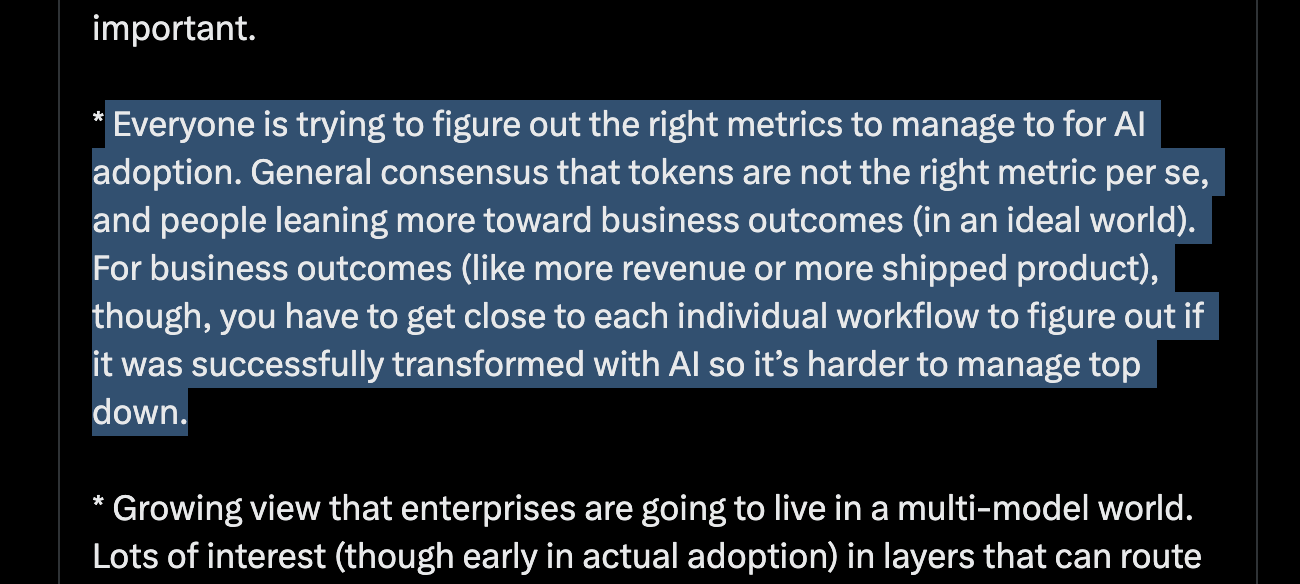
All of these are much fuzzier questions, and FDEs will be under a lot of pressure to deliver results quickly, sometimes too quickly to validate whether a new way of operating is working or not; especially where it comes with change management for humans.
Afterthoughts and side quests
Can FDEs uncover enough “standard” processes to ossify them into products that can be sold (out-of-the-box agents, workflows, scripts)? FDEs are essentially a discovery surface for new products.
The success of individual company’s FDE teams depends on how they’re structured. How much of this is “I actually work on site next to the buyer, watch them work, see the muck they won’t verbalize” vs. “I visit on-site occasionally and we review and collect feedback” vs. “I meet with them on Zoom every two weeks”. The muck is hard to spot if it relies on the customer’s ability to identify the “automatable” or “solvable” problems, cutting into the exact expertise an FDE is there to provide.
Here’s what the rest of the industry says about FDEs:
Gergely Orosz expects the demand to increase, and, quoting Aaron Levie, points to them as an opportunity to break into the industry, especially for new grads: two observations I agree with.
Vas, CEO of Varick Agents, wrote an entire piece on the FDE demand and how to capitalize.
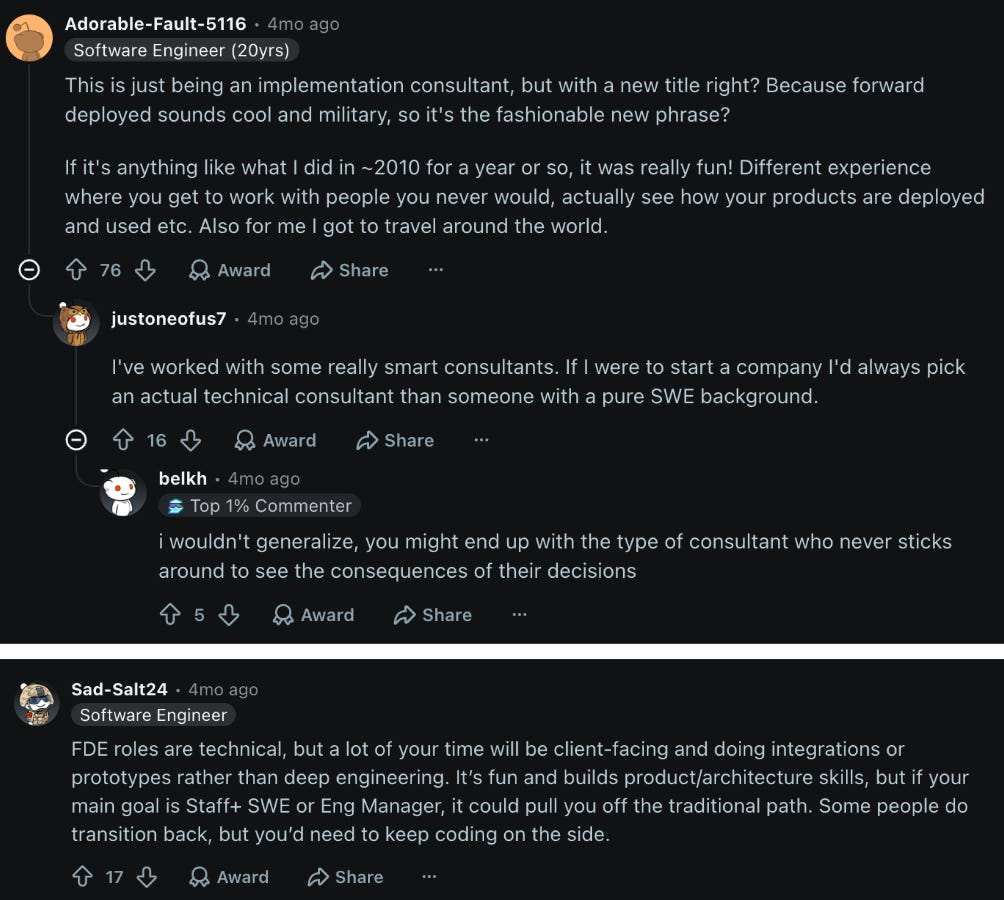
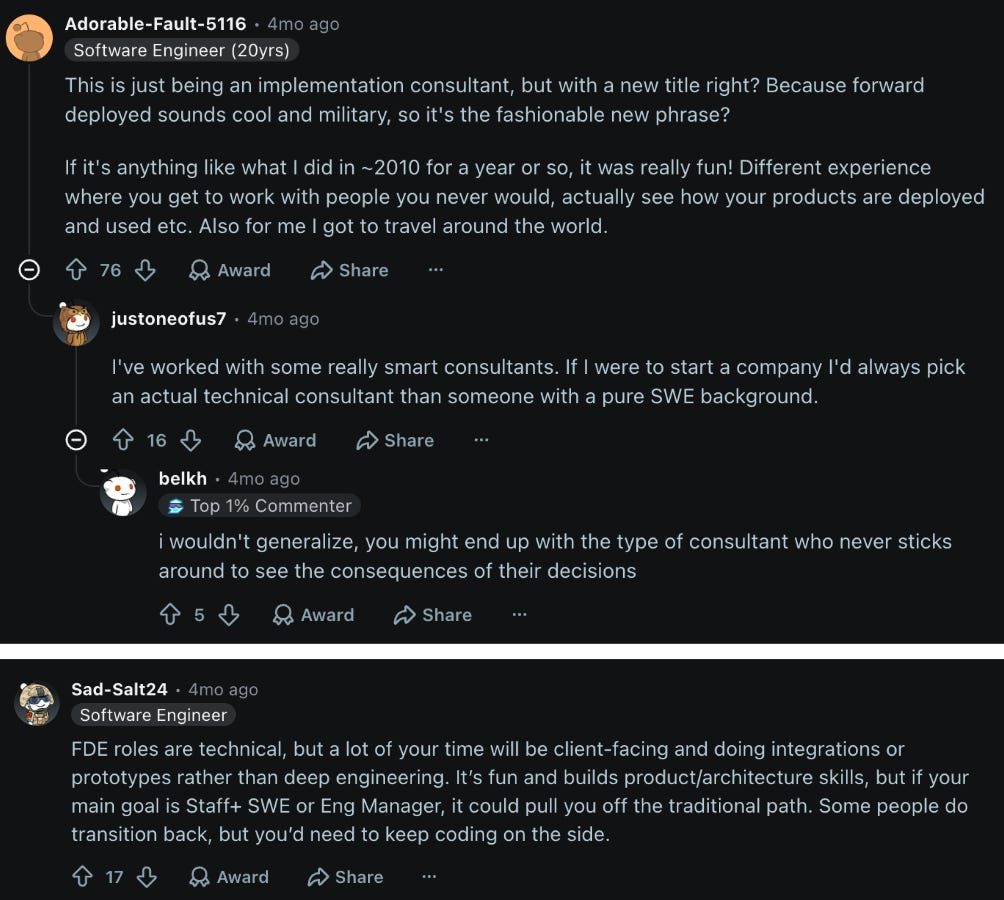
Quick scan through engineering forums on reddit seem to echo that FDEs are essentially solutions consulting but cool
Bluewolf, one of the big agencies, actually “founded” customer success: Berridge, E. (2016). Customer Success: How Innovative Companies Are Reducing Churn and Growing Recurring Revenue. (Written by the founder of Bluewolf; explains the philosophy change).]